

The first treasure California began to surrender after the Gold Rush was the oldest: her land.

Pickaxe and Shovel

Remnants of 1849

Malcolm J. Rohrbough, a gold rush historian, described the California Gold Rush this way: “Environmentally, the discovery of gold was a disaster… People described the California landscape as looking like it had been dug up by giant moles.”

This frenzied period left pervasive mercury contamination from amalgamation that still exists today, depleted wildlife through polluted ecosystems and game hunting, drove vast deforestation from hydraulic mining, and altered river systems in ways that destroyed natural habitats and ruined agriculture.

At the same time, the Gold Rush also transformed California from a once-rural expanse into a state dotted with booming cities and towns. The accompanying population growth and economic boom also played a major role in the creation of America’s First Transcontinental Railroad. As it turns out, the lasting impact of the Gold Rush had little to do with gold in the end — the environmental, socioeconomic, and infrastructural effects proved far more consequential. Even with all the hysteria around gold at the time, California’s first millionaire, Samuel Brannan, was not mining for the precious bullion. He instead focused on selling the shovels, pans, and pickaxes to eager gold miners.

Today’s AI race is also changing the socioeconomic and environmental landscape. Jobs are being displaced on a massive scale, thousands of data centers are accelerating carbon emissions and straining power and water resources, AI models are trained on copyrighted works without compensating original creators, and human capital is diminishing due to an over-reliance on AI for writing and problem solving.

In the same breath, AI is boosting workplace productivity, advancing health care, and adding new conveniences to daily life. But as with gold, the long-term changes AI sets in motion will likely prove far more consequential than AI itself. And just as Samuel Brannan made his fortune selling picks and shovels to miners rather than mining gold himself, the real winners of the AI boom may be the chipmakers powering it rather than the AI companies built on top of it. So far this year, semiconductor stocks have significantly outpaced their hyperscaler counterparts.
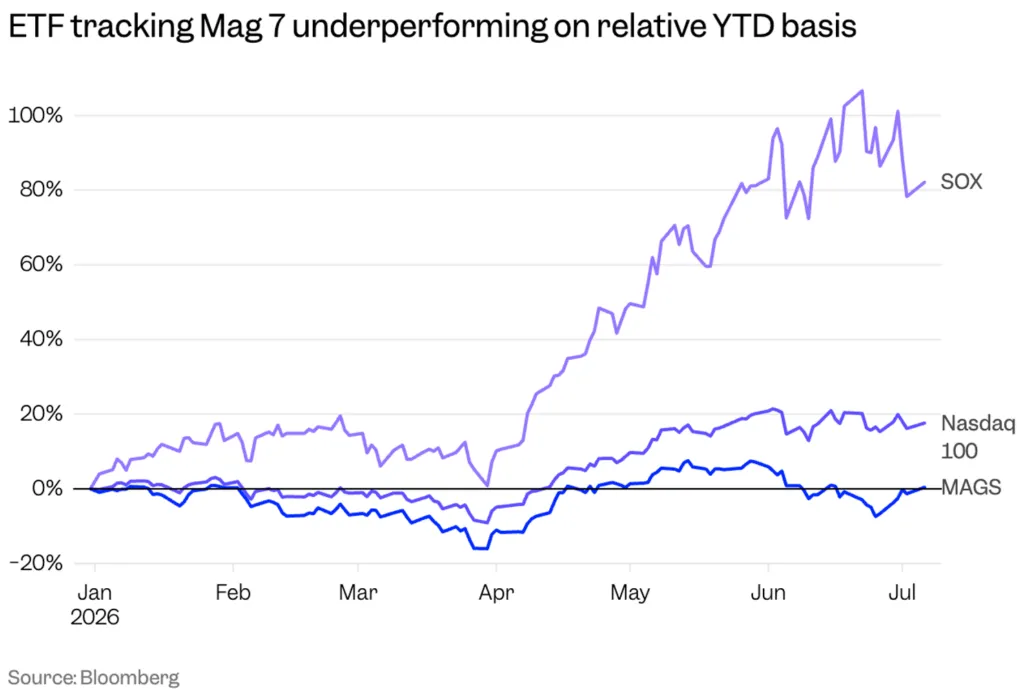
Semiconductor Outperformance

Following a market pullback from the Iran War, US stocks just had their best quarter in six years. The S&P 500 rose 15.2% in Q2. With oil prices having dialed back from the April and May highs, investor focus has shifted back towards company earnings, which are notably optimistic heading into reporting season.

An Earnings-Driven Market

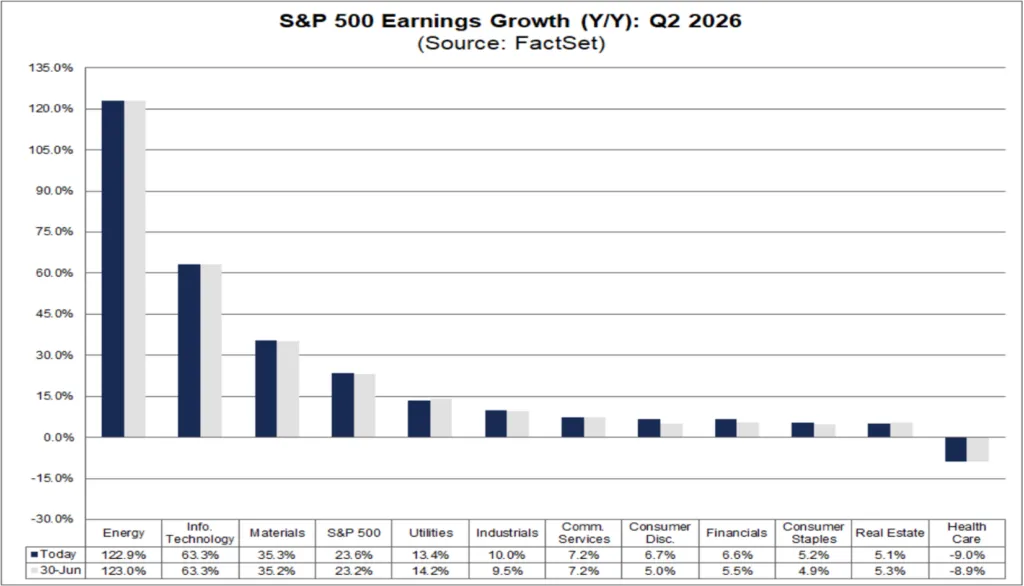
For Q2, S&P 500 earnings are expected to grow by 23.6% from a year ago, which if realized, would mark the second consecutive quarter of earnings growth exceeding 20%. At this point, FY2026 earnings are forecasted to rise 24.2%, which would double the actual earnings growth of 12.1% in 2025 and more than triple the market’s long-term average of 7.5%.

In recent months, earnings are growing faster than stocks. Through July 10, the S&P 500 rose 10.7% since the start of the year. By comparison, earnings estimates rose 18.5%, which means that forward P/E multiples have contracted by nearly 8 percentage points, according to Piper Sandler.

SP 500 Forward PE

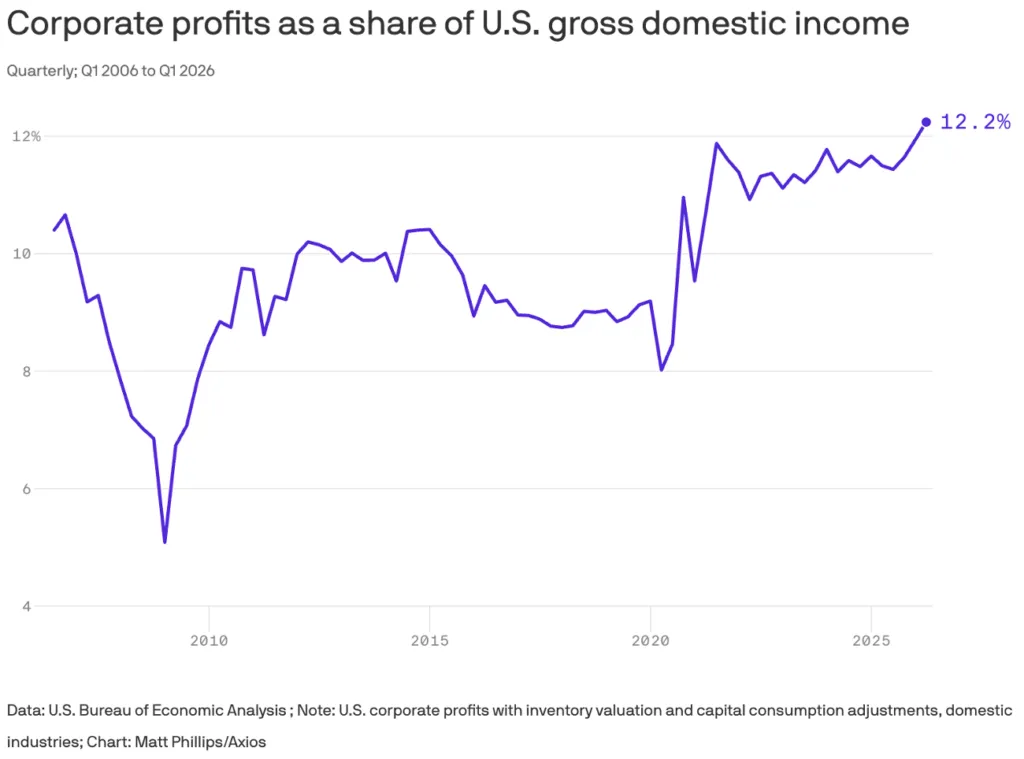
In late-June, the US Commerce Department indicated that total domestic corporate profits in the US now make up 12.2% of gross domestic income – the highest share of the economy since the early 1950s.

Corporate Profits Share Of GDI

Winner-Take-All Market

The recent earnings acceleration, though, is looking uneven. The energy and technology sectors constitute the large bulk of the expected increase. According to Bloomberg, AI-related investment now accounts for more than 25% of GDP growth, and AI-spending has reached 8% of overall GDP. That exceeds the level of tech investment that reached 6.5% of GDP at the height of the dot-com bubble.

SP 500 Sector Earnings

This historic level of investment is driving a larger wedge between the haves and have-nots. According to Deutsche Bank, the top decile of listed companies by market value now account for more than three-quarters of the total corporate market capitalization in America – the highest share in a century.
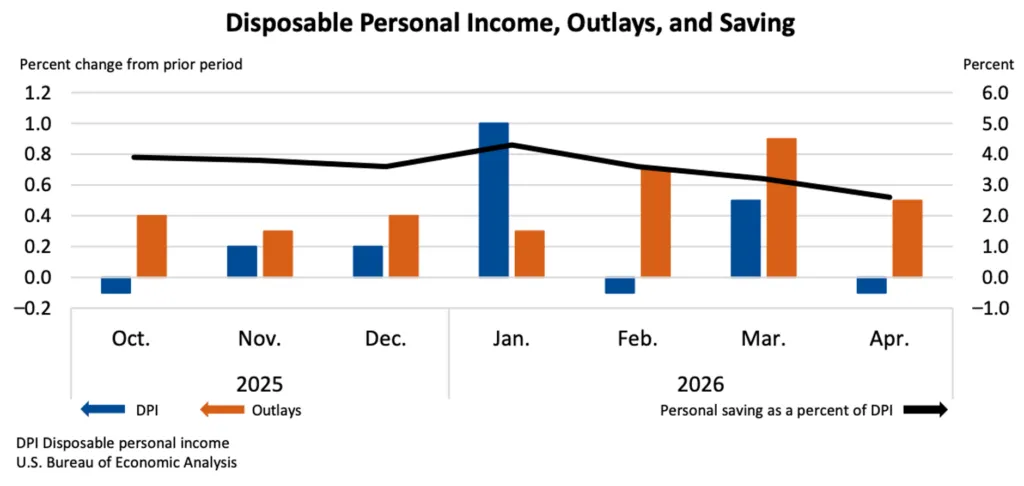
The prospects for the broader economy outside of AI, however, look mixed. Consumer spending is slowing and economic growth appears to be weakening compared to recent years. In April, the US personal savings rate fell to 2.6% as gasoline prices took a large bite out of paychecks and pushed inflation past wage growth.

Declining Savings

Losing Hope for Employment

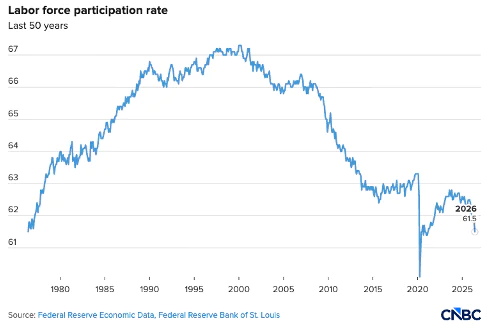
Wages are under pressure from a weakening jobs market. June’s job report fell well short of expectations, with payrolls up by just 57,000 — roughly half of analyst targets. More concerning was the labor participation rate, which measures the share of the working-age population either employed or looking for a job. Excluding the Covid era, the participation rate fell to 61.5%, the lowest level in 50 years.

Labor Force Participation

Individuals who have been looking for work for 27 weeks or more, classified as long-term unemployed, are making up a rising share of the unemployed population. Consequently, rising pessimism toward finding work is causing dejected jobseekers to eventually drop out of the labor force, which in part explains the low participation rate. The low participation rate also helps reduce the unemployment rate, which doesn’t include individuals who have stopped trying to find work.

Of the nearly two million people who have been out of work for more than half a year, those between their mid-20s to mid-30s make up the largest share. The 55+ cohort, by comparison, saw its participation rate fall to a 21-year low of 37.1%, which indicates that this group is the most likely to choose to be excluded from the labor force.

Perhaps the largest contributor to the recent lack of hiring is related to historic spending from America’s largest tech companies. While increased business investment has often correlated with greater job opportunities, the historic level of capital spending is displacing white-collar workers in two ways: 1) technology is automating away roles previously done by human workers and 2) jobs are being cut to free up cash flow for additional investment.

55 Labor Participation Rate

Corporate Debt Fueling AI Investment

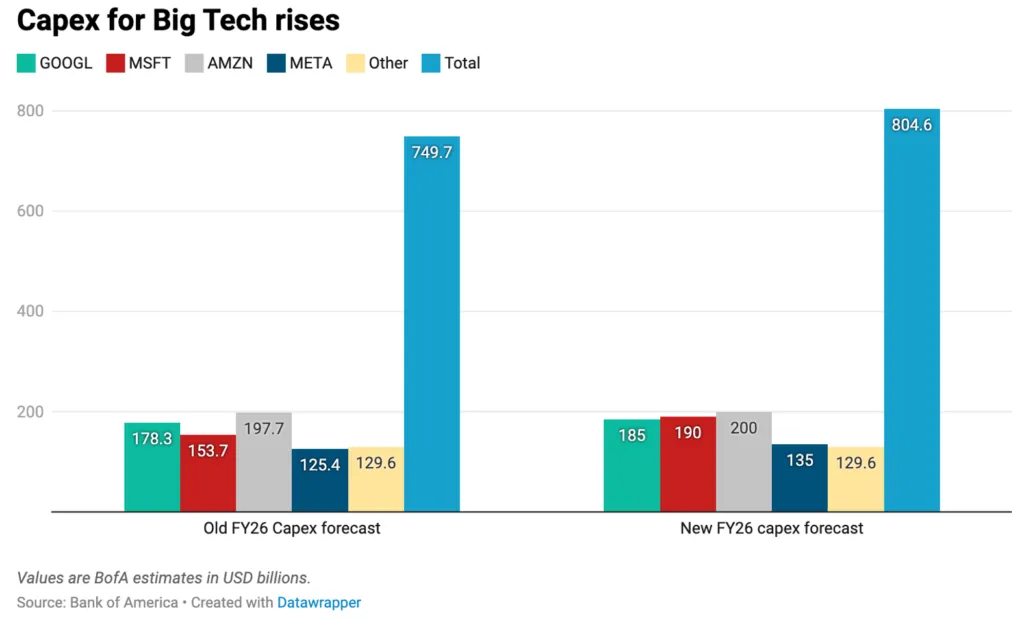
The world’s biggest tech companies have raised their capex targets for the year to around $800bn. By next year, analysts are already expecting the level of investment to exceed $1 trillion.

Big Tech Capex

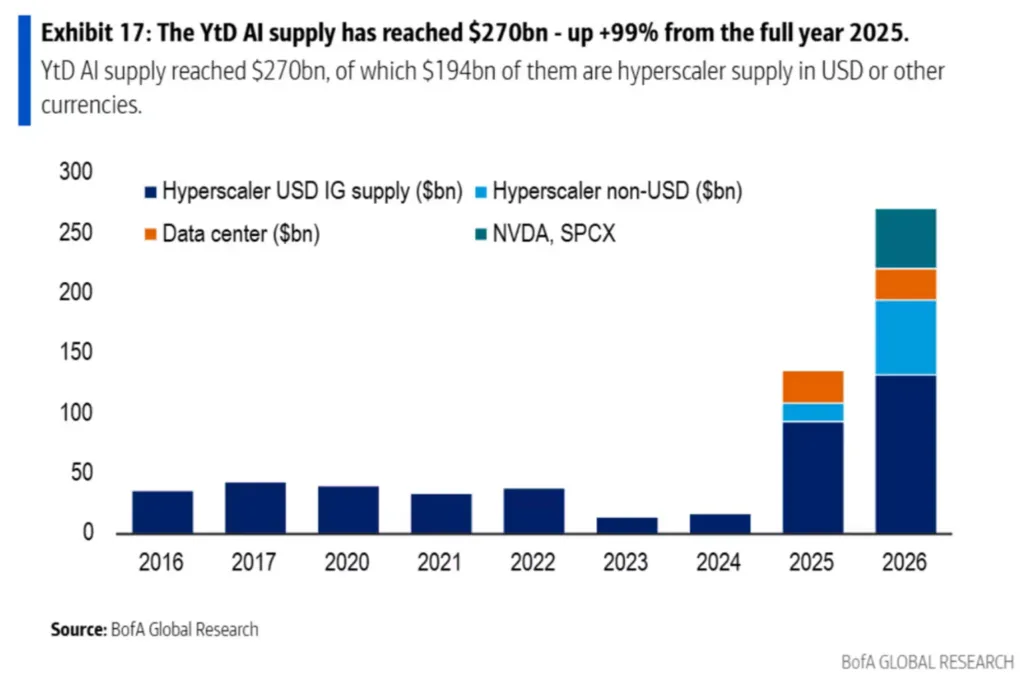
Such ambitious targets cannot be met through regular profits or cost-cutting. Companies are increasingly turning to the capital markets. Already in 2026, AI-related corporate debt has increased 99% from a year ago to $270 billion. Bank of America and Goldman Sachs forecast $2.1 trillion of investment grade debt supply this year, which would rival 2020 pandemic levels when the federal funds rate was near zero. Despite the myriad of high-profile equity offerings and IPOs this year, the bulk of the AI financing is expected to come through the corporate debt market.
Investors are already showing signs of waning risk appetite though. Amazon’s recent $25 billion debt deal, which ordinarily would sail through with little resistance, traded poorly. The anticipated flood of debt issuance is already putting pressure on corporate bonds.

AI Debt Issuance

A New Sheriff in Town

Further pressure on the bond market is also coming from the Federal Reserve. New Fed Chair, Kevin Warsh, is drawing a hard line against inflation – a stance many investors didn’t foresee following his nomination from President Trump, who has been outspoken about his desire to see interest rates reduced. Instead, the Fed Chair has repeatedly insisted that his committee will not tolerate high inflation, which has steered the bond market into pricing in a roughly three-in-four chance of a rate hike by year-end. Kevin Warsh has decidedly taken a different approach from Jerome Powell, his predecessor. Warsh intends to provide less visibility to investors on the Fed’s outlook – a style that appears more akin to Alan Greenspan.

It Goes Deeper than AI

Just as the Gold Rush’s real fortune flowed not to the miners but to the merchants, railroads, and cities left in its wake, the spoils of the AI boom will reveal itself over time. In recent months, we are seeing chipmakers trumping software, corporate debt taking over balance sheets, and a shrinking handful of giant tech firms hovering over the broader economy. While earnings are on a historic run and the stock market has just enjoyed one of its best quarters in years, there are real strains lying beneath. The labor market is shedding white-collar jobs, consumers’ savings cushions are shrinking, and the new Fed chair appears less willing to bail out markets than his predecessor. The Gold Rush took decades to reveal which of its effects would actually last. The AI boom may not offer investors that same luxury of time — which is exactly why understanding who’s really capturing the value, and who’s bearing the cost, matters more than the boom itself.

Jeremy Lau

Jeremy L. Lau serves as Chief Executive Officer. He teaches the Investment Management course for California State University, Fullerton’s Trustee Certification Program and frequently speaks on fiduciary investing to attorneys and fiduciaries across various associations. Before joining Prudent Investors, he worked as an Executive Director in investment banking in Tokyo and Hong Kong for Deutsche Bank AG and UBS AG in structured credit and convertible bonds. He graduated in Accounting (with Honors distinction) from Brigham Young University and has earned the right to use the Chartered Financial Analyst (CFA®) and Certified Financial Planner (CFP®) designations.