



Golf fans will remember the tragic meltdown of Greg Norman thirty years ago at the Masters in 1996. A dominant first three rounds, including a course record-tying 63-shot first round at Augusta, placed the Australian legend known as “The Shark” firmly atop of the leaderboard with a seemingly insurmountable six-stroke lead entering the final round of the tournament. However, a combination of panic, paranoia, and missteps led to multiple bogeys and double bogeys on the back nine. Greg Norman would go on to lose the tournament to his rival, Nick Faldo, by five strokes. Norman, with a history of blown leads in major championships, was his own worst enemy that day.

A year into the second Trump administration’s term, the US economy has plenty of momentum going for it. An AI investment boom, accelerating GDP growth, and an improving fiscal picture has pushed the S&P 500 towards 7,000. Some estimates now put the US share of the global stock market at around 60-65%, nearly doubling its global share from the late-1980s.

However, a mix of political uncertainties and geopolitical tensions, including strained foreign relations, onshore political divisiveness, and questions about the limits of executive power risks compromising this expansion. Understanding how these factors interact with current economic developments will determine whether this current growth cycle can be sustained.
In 2017, many pundits warned that the Tax Cuts and Jobs Act combined with new trade tariffs would trigger a surge in inflation, slower growth, a spike in the deficit, widespread unemployment, and a selloff in the bond market. Similar fears resurfaced in 2025 around “Liberation Day,” when the administration unveiled a global 10% baseline tariff and a set of reciprocal duties, which has since partially been rolled back.
Those scenarios did not occur during President Trump’s first term and they have not materialized so far in his second. Inflation, while still above the Fed’s 2% target, has eased to 2.7% in December from 2.9% a year earlier. Real GDP grew at a 4.3% annualized pace in the third quarter, its strongest performance in two years and Q4 GDP is forecasted to increase more than 5%. The federal deficit in 2025 actually improved from the prior year, unemployment remains subdued at 4.4%, and the bond market has remained broadly stable.
So what is different this time? The United States has taken more assertive geopolitical action in President Trump’s second term. Both the use and the threat of military force have heightened tensions with key rivals, while a tougher and more expansive immigration enforcement agenda has intensified domestic political conflict. These dynamics have deepened polarization in America. Nearly half of the country now identifies as politically independent, a share that has risen sharply in recent years.

Productivity growth, long considered the economic holy grail, allows output to expand without stoking inflation. Nonfarm business productivity surged to a two-year high of 4.9% in the third quarter, as real output rose 5.4% while hours worked increased just 0.5%. Unit labor costs fell 1.9% over the same period. A combination of heavy AI-related investment, a rebound in business activity, and strong consumer demand, alongside much slower hiring, drove this jump in efficiency.

The slowdown in hiring has been particularly striking. The economy averaged job growth of 49,000 per month in 2025, roughly 70% fewer than in 2024. Yet economic growth is accelerating while consumer spending rose a stronger-than-expected 3.5%. AI does not yet appear to be causing widespread job losses, as evidenced by relatively stable jobless claims, but it does seem to be allowing firms to scale output with fewer additional workers.

While the economy has benefited from stronger productivity, the U.S. fiscal picture has also improved. After years of widening deficits, the federal budget shortfall fell 2% ($41 billion) in 2025 (fiscal year ending on September 30)—the first annual decline in a decade, excluding the pandemic years. According to the Congressional Budget Office, the deficit is estimated to have narrowed to 5.9% of GDP in 2025, down from 6.4% in 2024. Federal revenues rose by $317 billion (6%), outpacing the $275 billion (4%) increase in expenditures.
On the spending side, the largest decline occurred at the Department of Education, where outlays fell by $233 billion. By contrast, contrary to the perception of many, entitlement spending rose. Outlays for Social Security, Medicare, and Medicaid increased by roughly 8%, reflecting the growing retiree population and the rapidly rising cost of health care.
On the revenue side, individual income tax receipts increased by $230 billion and payroll taxes by $39 billion, reflecting solid labor income growth. Corporate tax receipts, however, fell by $78 billion, largely due to deductions permitted under H.R. 1, the One Big Beautiful Bill Act. Perhaps the most notable additional source of revenue came from trade tariffs. Customs duties rose by $118 billion as the effective tariff rate climbed from 2.2% in January to around 16-17% by the end of last year.

Pivoting to other territories in the western hemisphere and setting aside the political, ethical, and military defense considerations around Venezuela and Greenland, the excavation of resources in both countries presents unique challenges.
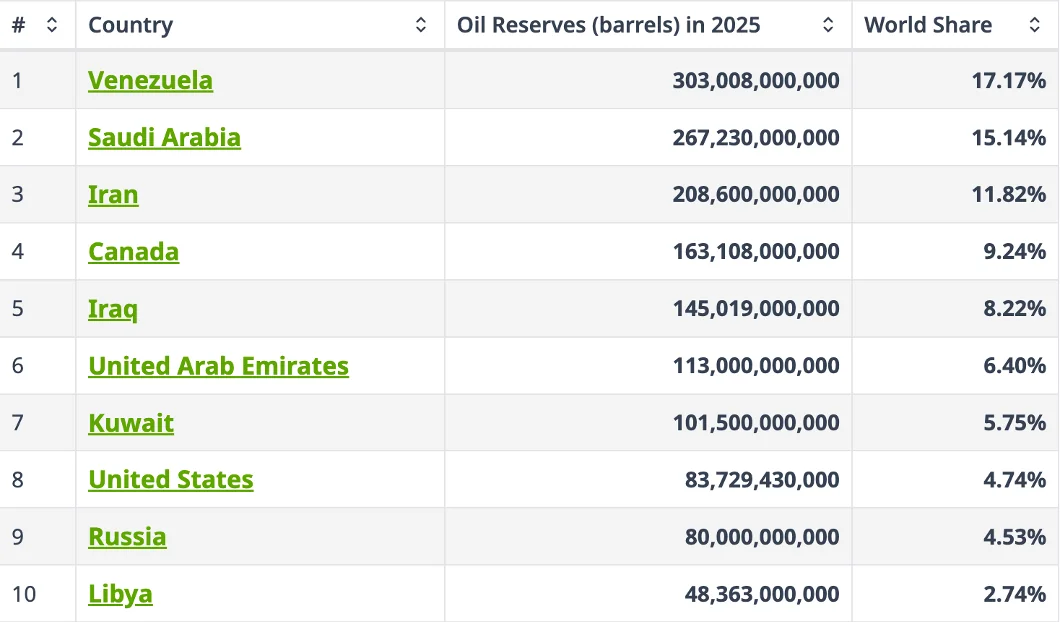
Venezuela is estimated to hold over 300 billion barrels of oil reserves, which would account for 17% of the global share. While the country used to produce nearly 3 million barrels of oil daily, that figure has fallen to around 700-800k in recent years due to a combination of government corruption and instability, lack of reinvestment, and sanctions. Restoring production to 80% of capacity is estimated to require $10-20 billion of investment and many experts estimate around $100 billion would be needed to revitalize the entire sector. With oil prices hovering near 4-year lows, US oil companies are reluctant to invest significantly, and the payback is estimated to take several years even under stable conditions.
Greenland, according to the U.S. Geological Survey, contains around 1.5 million tons of rare earth elements classified as proven or economically recoverable, which would place the country 8th in the world for rare earth reserves. While those are verifiable estimates, broader geological studies have suggested Greenland’s reserves could be significantly larger, with some estimates as high as 30-40 million tons. The Atlantic Council believes Greenland could even possibly contain the world’s second largest rare earth reserves after China. Currently the country has no commercial rare earth production as much of the land is under ice with limited infrastructure. Furthermore, both local and national governments are cautious about environmental impacts. It is estimated that producing any meaningful supply of these minerals could take a decade or longer.
